
A Stress-Free Life

Sir C.P. Srivastava,  former secretary of Prime Minister Shastri in India and later on secretary-general of the London-based International Maritime Organization, a United Nations agency, gives a glimpse into his life with his wife, Shri Mataji Nirmala Devi at a conference about stress & tension management.

He narrates how the miracle of transformation of people took place in front of his eyes, something he could never believe was possible and a nice little anecdote about a homeless drug-addict his wife brought home one day. He continues with his own sometimes stressful career and how he himself became transformed into a calm and stress-free person.


https://vimeo.com/91460023

Meditation, mindfulness and mind-emptiness

 This article was published by The Conversation

Mindfulness essentially involves the passive observation of internal and external stimuli without mental reaction. Image from shutterstock.com

Ever been unable to sleep because you can’t switch off that stream of thoughts that seems to flow incessantly, mercilessly through your head?

When your mental noise distracts you from the task at hand, makes you forget why you walked into a room, or keeps you awake at night, you’re a victim of what is known in the East as “the monkey mind”. It is this thought stream that, according to Eastern tradition, is the source of much of our modern day stress and mental dysfunction.

So, what can you do about it?

Meditation

In the West, meditation has become a woolly term under which many different methods have found a home. Mindfulness is the latest, and certainly the most popular, addition.

Scientifically speaking, all approaches to meditation – be they relaxation, mindfulness, visualisation, mantras or otherwise – are associated with measurable but non-specific beneficial effects. So too are all stress management-style interventions even if they are not labelled as “meditation”.

So, does meditation have a specific effect or is it just another way to relax and de-stress? These are the questions that the scientific community continues to struggle with. Importantly, we can only answer this question if we have a clear understanding of what meditation is (or isn’t).

Our research shows that by defining meditation as “mental silence”, which is an evolution of the mindfulness concept, we can effectively answer the key scientific questions about meditation.

Mindfulness

Mindfulness essentially involves the passive observation of internal and external stimuli without mental reaction. It is most explicitly, but not exclusively, laid out in Buddhist meditation texts.


The Buddhist connection is one reason Mindfulness is so popular. Image from shutterstock.com


Mindfulness has become immensely popular for several reasons: its connection with Buddhism, which is very much in fashion; its secular style; and its suitability as an adjunct to many other mental health counselling strategies such as cognitive behavioural therapy.

There is no doubting that mindfulness has a useful role to play in preserving health and promoting wellness. But despite its hundreds of clinical trials, there is no consistent evidence of an effect specific to mindfulness itself.

In fact, the vast majority of evidence concerning mindfulness relates to clinical trials that do not control for placebo effects. This is something relatively few researchers seem to want to talk about, either because it’s too difficult or too politically incorrect.

Mental silence

Perhaps surprisingly, the oldest known definition of meditation predates both Buddhism and mindfulness by thousands of years. In the ancient Indian Mahabharata, the narrator states that a meditator is “… like a log, he does not think”. In other words, the earliest definitions describe the key defining feature of meditation as an experience of “mental silence”.

Many other explicit examples of this definition can be found in Eastern literature from virtually every historical period. Lao Tzu, for example, urged us to “Empty the mind of all thoughts” in the Tao Te Ching.

Yet Western definitions of meditation have consistently failed to acknowledge its significance. Perhaps this is because of the predominance of the Cartesian dictum “cogito ergo sum” (I think therefore I am) that has come to characterise not only Western philosophy but the psyche as well.

This might explain why for most people in the West, including the academics and researchers on whom we rely to generate our scientific knowledge, mental silence represents both an alien concept and an illogical experience.

Yet the results of more than a dozen years of scientific research here in Australia tells us that mental silence-orientated approaches to meditation are in fact both achievable and associated with specific benefits above and beyond those seen in non-mental silence approaches.

Take, for instance, my 2011 Meditation for Work Stress Study, involving 178 full-time Australian workers; it’s one of the most thoroughly designed randomised controlled trials of meditation in the scientific literature.


Mental silence is responsible for many of the benefits of meditation. Carnie Lewis


Participants were randomly allocated to one of three groups: either mental silence meditation, a relaxation-orientated intervention (non-mental silence) or a no-treatment control group. Their stress, depressive feelings and anxiety levels were measured using scientifically validated measures before and after the eight week program.

While people in both intervention groups improved, those in the mental silence group manifested significantly greater improvements than the relaxation group and the no-treatment group.

randomised controlled trial of meditation for asthma sufferers mirrored these findings by comparing mental silence-orientated meditation to a stress management programme promoted by the state department of health. Not only were the psychological improvements significantly greater in the meditation group but there was also a reduction in the irritability of the airways.

Although further work needs to be done to identify the mechanisms, this change is likely the result of the modulation of chronic inflammation pathways, presumably through altered signalling from the brain.

Other larger surveys as well as smaller trials also demonstrate promising outcomes – all pointing toward the idea that mental silence is the key defining feature of meditation, responsible for effects specific to meditation.

Brain studies report some interesting findings. First, the experience is associated with a characteristic pattern of brain electrical activity – increased alpha-theta activity at the front and top of the brain along the midline. This is associated with reduced anxiety and improved attentional focus.

There was also a strong correlation between these objectively measured electrical changes and the subjective experience of the quality of the meditation experience.

Second, meditators exhibit reduced stress responses in the brain compared with non-meditators. This implies that the benefits are occurring at a neurophysiological level rather than being just a suppression of emotion or of its peripheral features.


The effects of meditation seem to be beyond the ability to suppress emotional responses.Flickr/premasagar


Meditators, therefore, seem to be fundamentally modifying the way they generate negative emotions in response to the environment.

Reduced negative emotional reactions to stimuli should logically lead to reduced stress and an improved sense of well-being. But until studies where the brain changes are simultaneously measured alongside clinical changes, we can’t definitively state that these brain changes are the cause of the specific effects uncovered in our clinical studies.

Mind-emptiness

So how does this all fit together?

The mental silence paradigm is both complementary to and a progression of the mindfulness concept. While mindfulness involves the passive observation of stimuli with the aim of reducing mental reactions, mental silence involves progressing this experience to, and attaining, a state of no-mental-content-at-all, while remaining in full control of one’s faculties.

The original intention of mindfulness is as a method to facilitate the attainment of mental silence rather than being an ends in itself.

This shift in our understanding resolves many of the paradoxes that were hitherto insoluble – while at the same time offering consumers and clinicians a practically useful way to understand and benefit from meditation.

You can try the evidence-based techniques that we have evaluated for yourself by going to www.beyondthemind.com.


Ramesh Manocha is the author of Silence Your Mind, published by Hachette.

What I learned from the Russian-Ukrainian conflict

I would like to share this article of a dear friend of mine, Axinia. These questions are worth to introspect on. It is only a few people in the world who create all these problems because of greed for power, money or something else. But in general people all over the world in all the countries, people like you and me, just want to live their lives in peace. But to achieve that we have to start with ourselves, we have to find peace first within, then with the others, and go beyond all these misleading ideas that – instead of uniting us – separate us.

axinia's avatar1000 petals by axinia

IMG_0385 image by axinia

Since I am Russian and my beloved husband is Ukrainian, the story of the ongoing Russian-Ukrainian conflict around Crimea and more has a lot been in my attention. And because I have no TV at home and read Internet very selectively I could more or less survive the information war. But even if I try to minimise the information flow by getting possibly the first-hand impressions and facts from the people involved, I am still getting a lot of buzz from the world Russian-Ukrainian community…. It is really hard to stay cool!

However the hardship of the situation helped me to learn two great lessons. And I hope many more people will be able to see it in the same way.

1. THE TRUTH CANNOT BE SEEN IMMEDIATELY.

This is something we learn throughout the history of humanity but obviously always forget when something happens: We are not able to…

View original post 330 more words

The Universal Being That You Are

1421_467059500054287_217527360_n”Everything is fleeting that is not eternal.
In the present the eternal stays, the rest drops out.

It’s like a moving river that does not stop anywhere, but the moving river is eternal, the rest of the things are all changing.

If you are on the eternal principle all that is not eternal changes and drops out, dissolves, and becomes non-existent.

You have to enjoy the strength of eternity, the strength of divine love, the strength of this universal being that you are.”

Shri Mataji Nirmala Devi. Delhi. 30.3.76

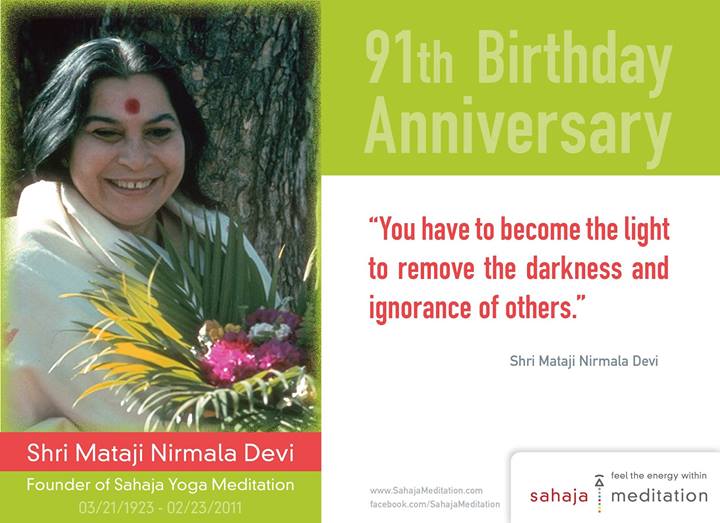
Happy 91th Birthday, Shri Mataji!

1956748_10152286750632766_1931749693_o

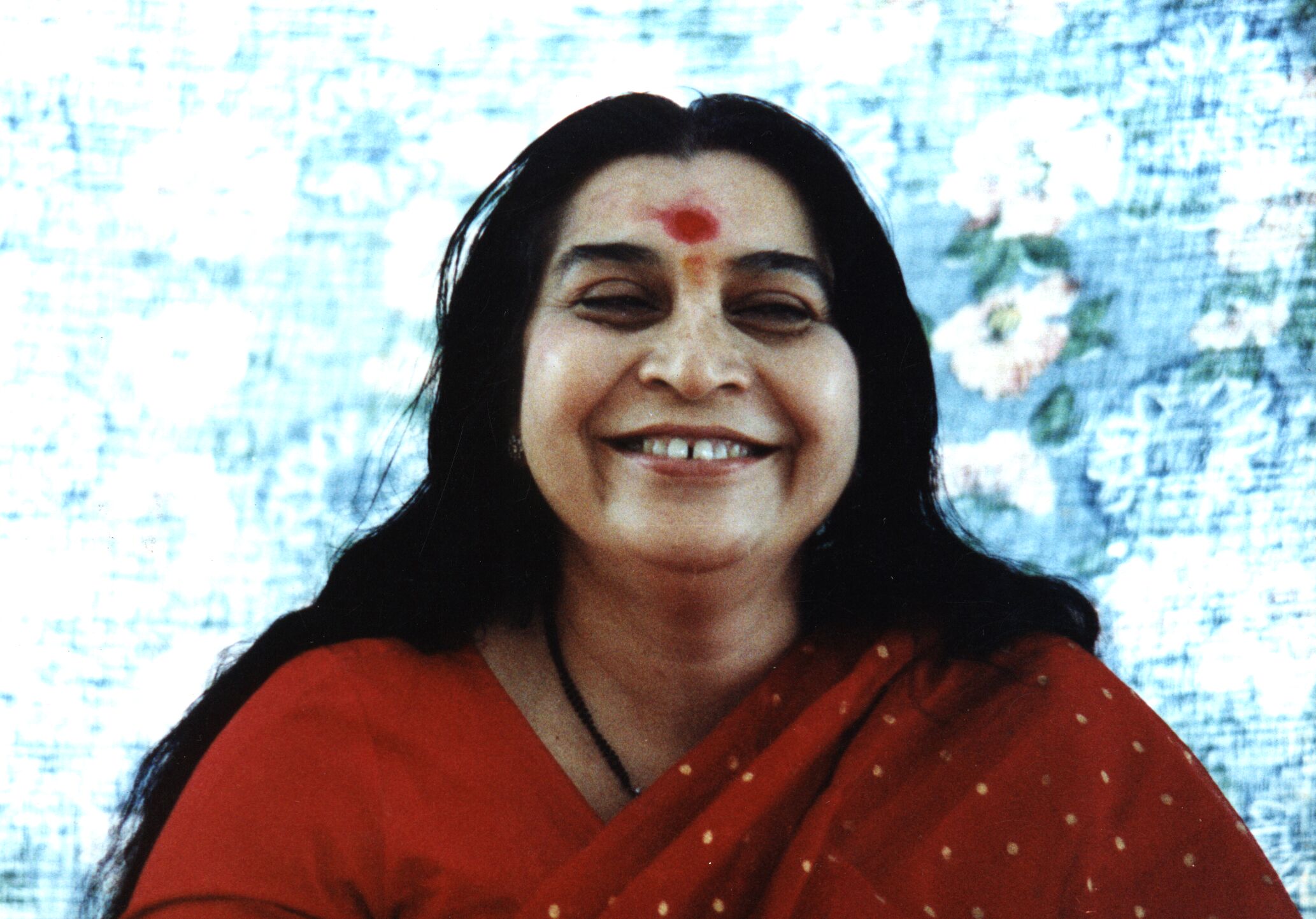
Today millions of people around the world are celebrating the 91th Birth Anniversary of Shri Mataji Nirmala Devi – the Great Spiritual Leader, the Great Visionary. In recognition of Her strength, love, devotion and compassion, many people call Her “Mother”. Those of us who have not heard or read about Shri Mataji Nirmala Devi could be surprised that the personality of such stature has not reached their awareness before… The impact of Her work and Her contribution to the well-being of humanity as a whole is hard to estimate.

Read about Shri Mataji’s international awards and recognitions here:http://wp.me/pkWjn-4I

Science meets Meditation

In this video Professor Katya Rubia, Professor of Cognitive Neuroscience from the Institute of Psychiatry, King’s College, London presents an overview of Scientific Research into the health benefits of Sahaja Yoga Meditation, which is always offered free of charge.


https://vimeo.com/89101187

Topics in this overview are:

the 4 states of consciousness, de-clutter your brain, obsessive thinking, schizophrenia, ADHD, better attention, better productivity, feeling of joy and bliss, anxiety, depression, enlightenment, Buddha, Holy Ghost, detachment, better physical and mental health, love, compassion, decrease in blood-pressure, decrease in heart-rate, effects of mental silence versus mind-fullness, stress, strong emotional feelings, positive emotions, deep concentration, paranoid thinking, “getting high” without drugs through meditation, addictions, detachment, work-stress, emotional stress, resilience to negative impacts, epilepsy, menopause, asthma, hormone replacement therapy,  positive effects of Sahaja Yoga Meditation versus other forms of meditations and/or therapies

50 Balloons and Happiness

cool-story-balloon-self-motivation-happiness

Once a group of 50 people was attending a seminar. Suddenly the speaker stopped and decided to do a group activity. He started giving each one a balloon. Each one was asked to write his/her name on it using a marker pen. Then all the balloons were collected and put in another room.

Now these delegates were let in that room and asked to find the balloon which had their name written, within 5 minutes. Everyone was frantically searching for their name, colliding with each other, pushing around others and there was utter chaos.

At the end of 5 minutes no one could find their own balloon.
Now each one was asked to randomly collect a balloon and give it to the person whose name was written on it.
Within minutes everyone had their own balloon.

The speaker began – exactly this is happening in our lives. Everyone is frantically looking for happiness all around, not knowing where it is. Our happiness lies in the happiness of other people. Give them their happiness; you will get your own happiness.

Unburden Yourself

Usually our life looks  pretty much like this:

58798_173571456131025_1827030024_n

Sometimes we do not even have a goal but still face the same challenges. Life can be demanding and sometimes simply overwhelming. Many seek medical or mental help which often results in the intake of drugs with heavy side-effects. No wonder that people are searching for alternative ways.

Nowadays meditation has become really popular and rightfully so! But while meditation in general gives a wide variety of health benefits it does not make you completely free of your problems.

Imagine you have to carry a sack full of stones throughout your life: if you have the choice, would you rather learn how to live with it or get rid of it?

Most forms of offered help show you how to live with your problems and still enjoy your life. With the awakening of the Inner Energy the problem can be removed entirely from your subtle system. Because you perceive yourself in a new way the awakening of the Inner Energy is also called Self-Realization.

It allows you to dive deep into your own personality to explore it, develop it or transform it. In the classes of Sahaja Yoga Meditation you can learn for free how to find out where there is a problem, why it is there and how to remove it. You will be able to develop desired qualities easily and get rid of unwanted ones. It gives you complete control over your life and yourself. It gives you Inner Freedom.

.

Here is a wonderful experience of a lady who speaks about her “Nabhi Chakra” (the third energy-center) and what happened after she started to bring it into a balance.

.

The Inner Energy is the key and Meditation the Door into a new dimension of the Self

Meditation as the state of being in thoughtless awareness is the focus point where everything starts.

Here is a guided meditation to awaken the Inner Energy by the founder of Sahaja Yoga Shri Mataji. But even if you have your energy awakened already this meditation helps you a lot to get into the state of thoughtless awareness. Try it! Experiment with it! It is always for free.

.

Although this blog tries to give as much knowledge as possible (see the step to step guide) and to lead you into the experience of your inner being it actually cannot really replace a collective meeting where you meet like-minded people and experience the power of collective meditations. Also every person might need something different or something more specific according to his/her state so the coordinator of a program can give you great advice that fits exactly to what you need or want to know.

Here is list where you can find the nearest Sahaja Yoga Meditation meeting.

It is all about you and your connection to yourself, to others and to life! And if we can experience it together and share it with each other the better!

Hope to see you all there!

Yours, Angi